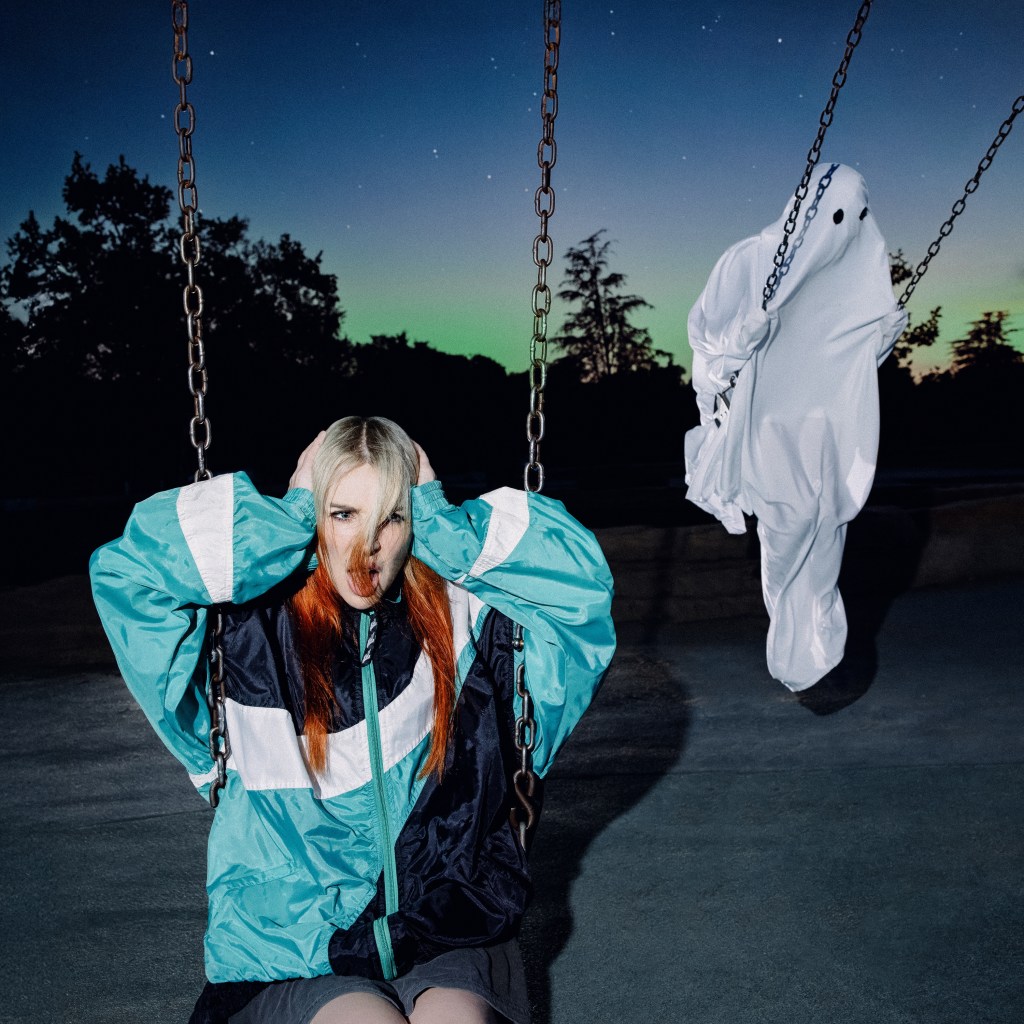
Ghost World documents the tension between a singular public identity and a restless creative instinct that refuses to be boxed in. Rather than treating that tension as something to resolve, Alison Wonderland turns it into a catalyst. The result is an album that thrives on contrast—melodic and punishing, nostalgic and forward-leaning, sometimes intimate and sometimes just physically overwhelming—with moments where all of it hits at the same time.
Right from the start, you can feel the purpose put into Ghost World. The lead-in title track is deliberate and hype-building, easing the listener into the world before “Get Started” quickly makes the album’s intent unmistakable. The latter opens in familiar territory—melodic, emotional, unmistakably old-school Alison Wonderland—but with a noticeable tempo boost that was more apparent on our second listen. Before that foundation can fully settle, the floor drops out into pure trap. It’s the album’s thesis in miniature: melody versus force, atmosphere versus impact, introduced early and unapologetically.
That early friction isn’t just an album-level choice; it echoes the split at the center of Alison Wonderland’s creative identity. Alongside her main work, she’s built a darker, more experimental, bass-heavy outlet in the side project Whyte Fang, and the push and pull between those impulses runs underneath the entire record. Ghost World isn’t interested in separating them—it lets them collide.
That collision also reflects the personal terrain she’s been open about in the lead-up to the album. Wonderland has described Ghost World as a document of rebuilding; an attempt to piece together identity, confidence, and creative purpose after a period marked by isolation and emotional exhaustion. It carries the weight of someone working out how to exist in public again while still protecting the private person underneath.

That kinetic push carries forward into “Everything Comes in Waves,” where the album’s motion becomes literal as well as emotional. It strikes a rare balance—hard-hitting without tipping into hard EDM, energetic but guided rather than overwhelming. It’s nostalgic in its build but modern in its punch, a track built for movement without sacrificing nuance. Far from a party-song outlier, it’s the opposite: a track that travels easily between settings. It would slot into almost any playlist without losing its identity.
In that sense, the track’s title quietly doubles as a description of how Ghost World itself flows. There’s a sense throughout the record that everything arrives in waves—impactful without being overwhelming, heavy without losing its emotional center. It hits hard, but carries a faint sense of nostalgia at the same time, recalling an era when EDM was as much about amplifying atmosphere as it was about maximizing the drop. Where so much modern festival-scale dance music relies on constant escalation, this album is willing to let tension breathe. Space matters here. Silence matters. When the bass finally takes over, it feels earned rather than engineered.
When the release finally comes, it hits hard. “PSYCHO” makes the album’s physical intent undeniable. The track leads with exposed vocals before knocking the listener back with crushing bass and distorted sub-bass. It’s one of the most direct reminders that Alison Wonderland still knows exactly how to weaponize contrast, pairing vulnerability with brute force instead of choosing between them.
Just as that intensity threatens to dominate the album’s identity, Ghost World deliberately pivots again. “Voices” settles into the kind of emotional soundscape longtime listeners will recognize immediately, recalling the atmosphere that first defined the Alison Wonderland catalog without trapping the album in the past. “Floating Away” follows that same impulse, re-centering the record inside the melodic EDM framework she built her identity on—proof that even as this album branches outward stylistically, it never fully cuts loose from its foundation.

Still, the album rarely lingers in one emotional or stylistic lane for long. “Again? Fuck.” briefly slips into hyperpop-adjacent territory, trading weight for velocity as brighter textures and sharper vocal processing take over. It’s one of the record’s quickest lane changes, and a clear signal that Ghost World is less interested in comfort than disruption.
That restlessness also shows up earlier with “iwannaliveinadream,” an especially interesting moment in the sequence. It’s the first time the album fully lands in the sound many listeners most strongly associate with mainstage Alison Wonderland. The melodic framework is familiar, but its placement inside an album that otherwise leans into darker and heavier territory may feel unexpected for anyone who hasn’t followed her broader evolution or the more sonically adventurous side of the Whyte Fang project.
Those left turns eventually converge in the album’s most self-reflective collision. On paper “XTC,” featuring Whyte Fang, instantly reminded us of the viral Spider-Man pointing-at-Spider-Man meme. In real life, it’s Alison Wonderland confronting her own shadow self in real time, with neither voice fully overpowering the other. Rather than resolving the conflict, the song lets the friction live, turning creative duality into one of the album’s most charged and self-aware moments.
Viewed as a whole, Ghost World increasingly feels like a record built on multiplicity rather than consolidation. Instead of choosing between her established identity and her darker alter-ego, Alison Wonderland allows those impulses to overlap, blur, and challenge each other inside the same body of work. The album never sounds paralyzed by choice—it sounds propelled by it.
That duality lands with particular force on a personal level as well. We grew up on the atmospheric side of EDM—Tiësto and Paul Oakenfold, and later figures like Kaskade—where space and melody carried as much weight as the drop. Over time, our ears drifted toward heavier dubstep and trap, chasing low-end impact and controlled chaos. Ghost World feels like those two instincts colliding in real time. It plays like the EDM soul tugging in opposite directions, mirroring the creative energy now swirling between Alison Wonderland, Whyte Fang, and whatever she might be planning next.
That sense of forward momentum also supports Alison Wonderland’s own description of Ghost World as a “no-skip album.” It’s a bold claim in an era where so many releases are engineered around isolated streaming standouts. We’ll own the bias. As long-time listeners we were predisposed to trust her on that. But the album’s ability to hold up over repeat listens reinforces the point. The sequencing is deliberate, the emotional arc holds, and even the stranger left turns serve the album’s internal logic. Nothing here feels like filler built to pad runtime or chase algorithmic favor.
Ultimately, for all of its internal tension and stylistic movement, Ghost World lands as a high-impact record. It’s dense, physical, and emotionally charged in a way that makes its biggest moments feel earned rather than manufactured. The album thrives on friction without sounding fractured, on contrast without losing cohesion.
Ghost World feels less like a reinvention than a stabilization point. An artist no longer separating her creative instincts into neat compartments, but allowing them to coexist, collide, and occasionally even collaborate. Here, that tension becomes the album’s strength.
It’s the balance that ultimately makes the record feel so complete. And if you’ll permit us to be cliché: yes—you can call it a banger if you want. It earns it.
Listen to Ghost World by Alison Wonderland:
Or on YouTube:
Or purchase Ghost World from the Ghost World Store.
Connect with Alison Wonderland:
WEBSITE | FACEBOOK | TWITTER | INSTAGRAM | YOUTUBE | SPOTIFY
What hearing protection do we use at concerts? The Loop Switch2:




Leave a Reply